Sunday, May 20, 2012

More masterpieces, R.!


So I read Masterpiece Comics, and it was terrific. I've written about it effusively, even fannishly, at GoodReads:

Masterpiece ComicsMasterpiece Comics by Robert Sikoryak

My rating: 4 of 5 stars


This is a book of short comics depicting stories from classic literature written and drawn in the style of familiar comic strips and comic books, usually with characters from the comics playing the roles of characters from the classics. This is a brilliant idea, but there are two distinct pitfalls Sikoryak has to avoid in order to make it work:

It can't be a wink-wink, nudge-nudge, painfully self-aware exercise in which the characters are constantly saying, "Hoho, we're little cartoon characters putting on Daddy's big literature boots! Aren't we all adorable and intellectual?" That joke gets old fast.

At the other extreme, it can't turn into a Classics Illustrated sort of thing in which the comics characters look like themselves but fully take on the personalities of the classic characters. The novelty value of Batman just rattling off lines from Crime and Punishment would lose its novelty value after about two panels.

But Sikoryak bypasses both of those dangers and instead creates something completely original, something that makes this weird idea live up to its full potential. His hybrid stories remain true to everything that's ridiculous, endearing, and true about the comics, and they illuminate the greatness and profundity (and occasional silliness) of the classics.

For example, take the rendition here of poor Gregor Samsa in Kafka's The Metamorphosis, with his outer insect state reflecting his inner alienation and existential crises. Through Sikoryak's twisted lens, we get a Kafka/Charles Schulz mashup in "Good Ol' Gregor Brown," in which the poor transformed fellow scuttles around in the familiar yellow-and-black shirt. It makes the weirdest kind of sense, doesn't it? Not that Peanuts ever got quite as bleak as Kafka, but it is, at heart, a deeply sad comic about a sincere, put-upon kid who can never get a break. The brilliance of this juxtaposition can be summed up in one line spoken by Lucy as Gregor's sister, Grete: "GREGOR, YOU BLOCKHEAD!"

There are so many other great examples—eleven of them, to be exact—in which material is skillfully matched to other material. Here's Little Nemo as Dorian Gray: "What? The portrait has changed! What a cruel expression! Um! Maybe I should apologize to Sibyl." This is a truly clever book by an artist with the utmost love and respect for works that have lasted and things that were once wrongly thought entirely disposable.


View all my reviews

 So there's that. But now I'm constantly thinking about what other masterpieces of comics and older literature Sikoryak could combine. It's a little tricky because the juxtaposition of each comic and classic has to be compatible and resonant without being too obvious. The least interesting story in Masterpiece Comics was the adaptation of Wuthering Heights as a Tales from the Crypt-style revenge horror tale. It's good fun, but it's less interesting than the rest of the collection because of course there are clear parallels between a ferocious Gothic novel of overheated passions and EC Comics' grotesquerie. So I wouldn't necessarily like to see anything so on-the-nose again. Anything like Heart of Darkness as a Tarzan-style jungle adventure would be plain cheating.

With that in mind, I've come up with a few ideas of my own:

"Something Is Festering in the Filthy Gutter of Denmark." Hamlet and Watchmen, with Rorschach as the prince. I'm not exactly sure how this would work; I just think it's a brilliant idea. There's the shared philosophical pessimism, the constant threat of violence and war, the protagonist's unresolvable parental issues, and the final high body count. Hamlet's antic disposition becomes Rorschach's ever-changing mask. Awesome.

"The Strange Case of Doctor Hobbes and Mister Calvin." I'm sure that a few hundred master's theses have been written by now about Hobbes and the nature of imagination and reality, so this one almost writes itself: just turn the tables and have Calvin be an ingrained but autonomous part of Hobbes's psyche. I really, really want to to see Hobbes as a symbol of Victorian reserve and repression, with Calvin's evil grin representing, as it often already does in the comics, the id run amuck. Yay.

"The Importance of Being Leroy." I'm kind of wincing at this idea, which would mean combining a play I love with a comic I hate. But the combination of Doctor Faustus and Garfield worked so well. And, really, when you strip things down to their essence, aren't the hateful one-liners in The Lockhorns just a neanderthal version of the brilliant ripostes in The Importance of Being Earnest? No, no, they're actually really not. Never mind. Forget about this one. It's a terrible idea. It seemed fascinating for just a moment. But no.

I also have a vague idea that Scott Pilgrim would work well as Tom Jones based on plot summaries and their shared tendency to digress, but I haven't actually read Tom Jones, so I can't really back up that one. I also have this weird impression that there's something Dickensian buried somewhere in Bloom County, but I can't think of anything coherent to do with that either. The solution, of course, is for Sikoryak to furnish us with more Masterpiece Comics and make it snappy. More, I say.

Friday, May 18, 2012

Future reading?


All right. Time to take another crack at this whole “regularly updated blog” thing.

Any given day, I usually remember all the books I’m in the middle of reading, and I tend to be pretty confident about what I’m going to read next. But I generally can’t predict what I’m going to read after that. My ongoing mental reading list fluctuates constantly, depending on which books I have checked out from the library, how work was this week, what the weather is like, and many other basically unmanageable factors. I devote a probably unseemly amount of mental energy to remembering five to ten books I would be reading right now, all at once, if I had that much brain and that many eyes. Sometimes I scribble out some titles in a notebook, but I’ve found that such lists are all too easily ignored or forgotten once written. So I assumed, until yesterday afternoon, that I had to encumber my mind with all these tantalizing book titles until I got around to reading them: that is to say, forever.

And then it dawned on me—dawned aggressively, almost irritatingly, as if my brain had east-facing windows and I’d left the blinds open a crack the night before so that the sun was prematurely obtruding on my slumber: “Oho! I have this three-year-old blog in which I rarely post anything because procrastination is such a finely honed skill of mine.  Keeping track of my fluctuating reading plans is actually a good use for such a blog. Instead of trying to remember all these book titles in my head, I shall publicly list them for my own benefit and the edification of the internet. Tra-la!”

Yes, I’m afraid my inner monologue actually sounds like that a lot of the time. I try to cope. Moving on to the books bottlenecked at the top of my to-read pile:

King City (424-page Catmonster), Brandon Graham

I’ve never quite figured out how to describe it. It’s a comic, stylistically similar to manga, set in a hilariously violent, dystopian city. It’s about a guy named Joe, a master thief, more or less, who has been specially trained as a cat master. His cat, Earthling, is a smart, relaxed, always slit-eyed creature who can do just about anything, become any tool or weapon, if given the right injection. That’s every bit as strange as it sounds, and it just gets weirder from there. There are noirish things happening in the story, with gangsters and a femme fatale and so forth, but the main thing is that you get to spend time with these characters in this weird, awesome world. I read the first third or so of King City last year, as the first volume of a projected series, and then found out that further publication of the series had been delayed for years; now the whole thing is finally available in one handy volume, which I will probably inhale in one sitting later this month.

Masterpiece Comics, R. Sikoryak

I’m a sucker for comics that make clever use of the classics. The League of Extraordinary Gentlemen is awesome that way; so is everything I’ve read by Michael Kupperman. But this guy, this Sikoryak... this man takes things to a new level. He can do near-perfect imitations of the drawing and writing styles of past and present comics artists—everyone from Winsor McCay to Jim Davis—and what he’s done is to recast classic works of literature in the style of those comics, with the drawn characters both retaining their own personalities and taking on the personas of the older literary figures. It’s both completely ridiculous and entirely appropriate: you end up with mashups like “Mac Worth” (Macbeth/Mary Worth), “Little Dori in Pictureland” (The Picture of Dorian Gray/Little Nemo in Slumberland), and, believe it or not, even “Candiggy” (Candide/Ziggy). I’ve read a few of the strips and now I must read all the rest. And then Sikoryak needs to furnish me with several more books like this.

2030, Albert Brooks

Brooks gave a great interview on The Daily Show last year promoting his first novel, which is about the eponymous year in which he predicts things actually will go to hell in America. He’s a funny man, so I put this book on my library holds list. Now I have a copy ready and waiting for me. End of story.

Bird by Bird, Anne Lamott

Now that I’m finally actually writing again, it’s past time to revisit the most practical, understanding, passionate, funny book about writing I’ve ever read. The third chapter alone—”Shitty First Drafts”—has been more helpful to me than most other books on the same subject. Consciously or otherwise, I’ve been using it to fight writer’s block since I was sixteen.

Great Expectations, Charles Dickens

My vague plans to read some Dickens sometime began to crystallize a few months ago after I read so many salutary articles, blog posts, and tweets on the two-hundredth anniversary of his birth. I want to read one of his most beloved books. David Copperfield? Nah, Jamie and I have been planning to read that one together, and she’s a bit busy for it right now. Bleak House? That somehow seems like more of an autumnal book, something good to read in October. Great Expectations it is.

So there it is. At the moment, I fully intend to read all of those as soon as possible. We’ll see how that works out.

Friday, July 8, 2011

The Possible Reading of Summer 2011

I really like to make summer reading lists. Even though I inevitably abandon my planned reading each year (there was this one summer when I actually read three whole books on my list before getting distracted by other, newer, shinier books), I keep making these things every year. Beyond the simple, compulsive pleasures of listmaking for its own sake, it’s nice to imagine that I’ll have enough downtime to read ten or more books in one summer, as unlikely as that may seem when I have love, work, outdoor concerts, summer movies, Muppet Show DVDs, and many other things ready and waiting to distract me. This time of year, I’m mainly drawn to books that look to be funny, light, short, and reasonably full of novelty, as well as compact enough to comfortably carry to the park and back (though I do have one rather unwieldy coffee table book on my list). Here’s what sounds good to me this year:

archy and mehitabel, Don Marquis

This will almost certainly be my favorite-ever book of free-verse poems written from the point of view of a cockroach telling stories about his urbane alley cat friend. (The premise is that the cockroach bangs out each poem on Marquis’ typewriter late at night; the poems contain no capitalization and little punctuation because a cockroach is not strong enough to hold down the shift key and hit other keys at the same time.) It’s also supposed to be one of the funniest books written about 1920s New York.

At Large and At Small, Anne Fadiman

Fadiman’s  previous essay collection Ex Libris, one of my very favorite books, deals with her passions as a bibliophile; this one, which I’ve heard is equally awesome, looks to be more broadly concerned with various of her life’s obsessions. Judging by her essay titles—“Ice Cream,” “Coffee,” “Moving”—some of her obsessions are shared by me.

Carnet de Voyage, Craig Thompson

Here we have the only book by Thompson that I haven’t read yet. I love Goodbye, Chunky Rice and Blankets, and this looks like a really nice change of pace for him: a travelogue stitched together from notes and sketches he took down while traveling in Europe and Morocco several years ago. Judging from the pages I’ve flipped through, his art just keeps getting better and better.

The Deltoid Pumpkin Seed, John McPhee

The most fun I had reading a book last year was when I finally got around to reading my first John McPhee book, Giving Good Weight, with its warm, observant essays about the New York Greenmarket, competitive pinball players, and eccentric chefs. I’ve heard this book is a good next step, and it definitely sounds intriguing enough: it’s about a hybrid aircraft—part airplane, part airship—conceived in the Seventies and shaped like, indeed, a prodigiously big pumpkin seed.

Feet of Clay, Terry Pratchett

I just have not read enough Terry Pratchett. It bums me out. I’ve read and loved several of his books, but I just don’t generally think of him when I’m looking for light reading. I’ve heard that this one, which deals in part with a murder mystery involving golems and werewolves, is one of his funniest, so I’m going to use it to try to get back on the Pratchett wagon.

The Gone-Away World, Nick Harkaway

Friends have been prodding me to read this novel about the aftermath of a very bizarre apocalypse for a couple of years, and I do love me some dystopic science fiction. Apparently there’s something to do with a thing called a Go-Away Bomb, which is supposed to be an effective deterrent because it permanently alters the fabric of reality within its blast zone. Amazingly, it doesn’t work quite the way it’s meant to. This one should be an enormous amount of fun.

The Graveyard Book, Neil Gaiman

Yeah, this is one I should really have read at least twice by now. I’m a fan of Gaiman in general, and his previous young adult novel, Coraline, is pretty much the best thing he’s ever done as far as I’m concerned. Yet somehow this book, which has been praised by people I love and respect and has now won seemingly every last award it was eligible for (the Newbery and Carnegie and Hugo! I mean, when does that ever happen?), hasn’t made it to the top of my stack yet. This requires rectification.

Hitchcock/Truffaut, Francois Truffaut

This is the large, unwieldy book on my list, full of anecdotes from Hitchcock’s filmmaking career, all the way from the mid-1920s to 1980, and illustrated with pretty black-and-white film stills and production photos. I expect to learn plenty about how some of my favorite movies got made.

Murder on the Orient Express, Agatha Christie

I actually read this one last month to get a head start on my list, and it was quite fun. I remembered the resolution of the mystery from having seen the movie version years ago, but that didn’t really take much away from it. It’s really one of Christie’s more audacious plots, perfectly in keeping with her normal formula and willing to take that formula to some of its more outrageous extremes. I’m being vague so as not to spoil anything; suffice it to say that Hercule Poirot is as incorrigible and amusing as usual, and setting the whole story on a snow-bound train adds some fun restrictions to the action.

Week-End Wodehouse, P. G. Wodehouse

Aah, this is the stuff. In the last two years, I haven’t even tried to get through a summer without reading a P. G. Wodehouse book. His writing, more than anything else I can think of, is perfect summer reading: fast-paced, utterly ridiculous, filled with some of the funniest jokes every written in English, and truly well-crafted and tightly plotted in a way that you might not notice because you’re laughing too hard. I’ve already talked about how I named my blog after a line of his; now I’m chuckling as I think of this one paragraph he wrote about the joys of playing with a rubber duck in the bathtub. Week-End Wodehouse is a selection of some of his best-loved stories and excerpts, including many that I haven’t read yet. I can’t wait.

N.B. I stubbornly refuse to put unpublished books on reading lists, even lists of books I probably won’t get around to reading anyway; nonetheless, I’ll admit that next week I’m planning to drop everything in favor of starting George R. R. Martin’s long-awaited (and sometimes rudely demanded) novel A Dance With Dragons, which will probably keep me up late at night like every other book in his Ice and Fire saga has already done.

Thursday, May 26, 2011

Swords on the Street

I’ve been taking an extended break between volumes of A Song of Ice and Fire, which has been eating up most of my reading time since last December. I finished the third book, A Storm of Swords, in early April, and I plan to start the fourth, A Feast for Crows, in the next couple of weeks. Once I’ve read Feast, I’ll be fully prepared to join the throngs impatiently waiting for the next one, A Dance With Dragons, which George R. R. Martin optimistically says will be out this July. 

 As I mentioned earlier, a novel in the Ice and Fire saga, once begun, is hard to put down—which is enormously inconvenient, as each book is six hundred to one thousand pages long in hardcover. Storm of Swords was at the high end of that range, and I plowed through it in two weeks while trying to do things like sleep and get to work on time. I specifically waited to start it until the day Jamie left for Chile. My friends didn’t really see much of me. That’s the kind of obsession a series like this encourages. I’ve heard it described as fantasy for people who aren’t interested in fantasy, and I think that’s fair, given the amount of fantasy clichés that Martin either subverts or completely ignores. For one thing, there’s very little good-versus-evil among his characters; what he goes for is something much more psychologically satisfying, with surprising but sensical plot twists and characters who nearly all have some nuance to them. Almost every character who appears to be an unmitigated villain in the first book develops some valid motivations in later volumes; and other characters who are generally honorable do some terrible, destructive things to preserve their sense of what’s right. Oh, and just about any character can die horribly at a moment’s notice. It really is fun to read, even so.

Anyway, after I finished Storm of Swords and decided to take a long break from all that medieval ultraviolence, the first book I picked up as an antidote was Alan Jay Lerner’s memoir The Street Where I Live, which a friend lent me a while back. Lerner was the lyric-writing half of Lerner and Loewe (writers of Brigadoon, My Fair Lady, and so forth), and part of the fun of the book was learning about something I had very little prior knowledge of—in this case, the musical theater craze of the 1950s. Lerner divides his book into three long chapters, each focused one of his last three collaborations with composer Fritz Loewe—My Fair Lady (1956) and Camelot (1960) for the stage, and the movie Gigi (1958)—with a few digressions on the larger history of American theater in general and musicals in particular.

I love both cultural history and behind-the-scenes stories, so I ate a lot of this up. Lerner has a nice, breezy style that can go straight from laying out a quick history of the rise of musical theater (I was surprised to find out that P. G. Wodehouse had a great influence on the lyric style of ’20s and ’30s musicals, though that makes a lot of sense, as Wodehouse himself thought of his novels and stories as musical comedies without the music) to the long and involved process of getting the rights to adapt George Bernard Shaw’s Pygmalion. (Basically, Lerner and Loewe chose to begin working on the play before being granted the rights, which convinced the pertinent British and American authorities that they would do something commercially viable with the property if they were given the rights. Something like that. It’s really quite convoluted, and I salute Lerner for describing it in the book better than I can here.)

The chapter on My Fair Lady is great fun, full of anecdotes about everything from Lerner’s terrible writer’s block to the low-hanging chandelier that captured Rex Harrison’s hairpiece. And, speaking of Rex Harrison, the jury is out on exactly what Lerner thought of him. He describes the infamously temperamental actor as a dear friend and a wonderful collaborator, and he blows off Harrison’s detractors—Harrison had detractors, from all I can tell, just because he was an ill-tempered little boy for most of his adult life—and then proceeds to tell stories that exemplify exactly the kind of bad behavior they were complaining about. So I don’t know if he’s speaking in code or what, but I thought I caught a distinct backhanded edge under Lerner’s ostensible praise of his old pal Harrison.

Be that as it may, Lerner’s a fun, engaging writer, especially when talking about his creative and commercial successes. The chapter on the making of Gigi drags a bit, but it’s appropriately short, and the chapter on Camelot more than makes up for it. Problems in the making of Camelot included the following: Lerner being hospitalized for severe ulcers; director Moss Hart having a heart attack (not his first) and literally being wheeled into the hospital just as Lerner was leaving; the play’s initial running time of four butt-numbing hours, which naturally caused a few walkouts in the audience; and a general combination of hubris and terrible luck. It went from a train wreck to a respectable hit almost overnight, after some judicious cuts and a performance of a few of its songs on The Ed Sullivan Show. And then it gained some unexpected cultural resonance, as its final lines (“for one brief shining moment” and so forth) were quoted by Jacqueline Kennedy the assassination of her husband, which moved Lerner so deeply when he found out about it that he walked twelve blocks past his house before he noticed he’d gone too far.

I think the unpredictability of success or failure is what I like most about both Lerner’s memoir and behind-the-scenes stories in general: no matter how professional and hard-working everyone is, you eventually have to leave your work at the mercy of the audience and let them decide if it’s going to take off, flop, or find any kind of lasting resonance. So, yeah, it’s well worth reading. Be prepared for a degree of sexism and egotism ameliorated by a lot of genuine insight and creative reflection. (Watch for his funny, affectionate portrait of legendary theater director Moss Hart: “One of Moss’s most endearing traits was his innocent surprise at being Moss Hart.”) Oh, and I should mention that you’ll want to have the soundtracks to all three musicals on hand for reference. My Fair Lady is the only one that I think is still full of memorable songs, but Lerner’s book will definitely make you curious about all those lyrics he was fussing over.

Thursday, March 3, 2011

Scrabbling.

My hands have made a guest appearance on Jamie’s blog. You can see it here, and while you’re at it, start reading Jamie’s stuff. She’s awesome.

That’s me behind Jamie’s stuffed axolotl, about to make my next Scrabble move. When that picture was taken, I was on the verge of breaking a severe losing streak against her (Jamie, not the axolotl). I won a couple of games—that one and the one after, I think—before slipping again and getting seriously owned in the next several games. I think she won by about a hundred points the other night. We play almost every night, so I expect to get better. Stay tuned.

Tales of the healing zephyr.

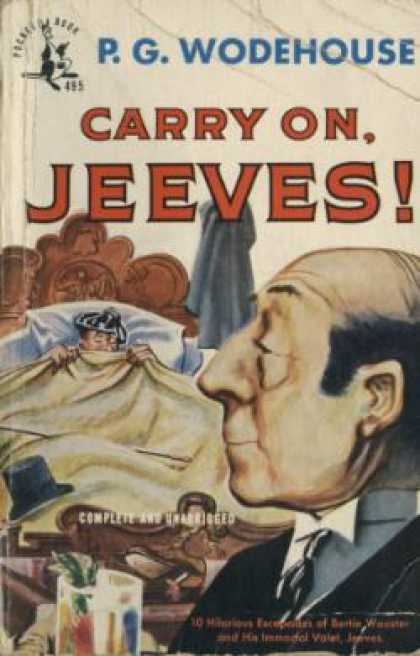
A couple of years ago, at Powell’s, I found a copy of P. G. Wodehouse’s Carry On, Jeeves that I needed to own, even though it was dinged up and a little delicate-looking. I decided I needed it for two reasons: it only cost $4.50, and it looked very much like this:


 It’s about as old as it looks (printed in January 1948), with vividly red inner covers, some adorably ancient fonts, and a slightly truncated size. It was released by Pocket Books back in the day when that publisher was interested in designing books that were actually meant to fit in a person’s pocket. Thus, it’s the same width as modern-day mass-market paperback, but maybe as much an inch shorter in length. And it looks like such a comforting book, doesn’t it? There’s Jeeves in the foreground with his serene near-smile and his famous hangover cure at the ready; Bertie Wooster, over on the left,  suffers beneath a large hot-water bottle, his personal effects strewn around the bed after a hard night of living the good life. The foundation of their relationship is right there, plain to see.

So I bought it that day, May before last, envisioning myself cozying up in the middle of winter with a cup of tea and some classic Wodehouse hijinks. And that is, for the last several nights, exactly what I’ve been doing. Carry On contains some early stories—they’re not the very first ones to feature Jeeves and Wooster, but Wodehouse probably wrote them shortly after he had worked out his major formula (Wooster or some pal of his does something foolhardy and gets into a trivially bad spot, only to be rescued at the very last by some effortlessly quick thinking by Jeeves). In any case, the first story in the collection is an origin story of sorts, in which the reader finds out  how Jeeves first arrived on Bertie’s doorstep to become his valet. No, sorry, “arrived” isn’t the right word—too simple; Jeeves hardly ever just “arrives” or “walks” anywhere: as Wooster would have it, he just “shimmers in” or something when his presence is required. The happier Wooster is to see him, the more Jeeves’s sudden appearances are divorced from any particular relationship with gravity. There’s this, for example, from the climax of “Jeeves and the Unbidden Guest”: “Jeeves had projected himself from the dining-room and materialised on the rug.”

I’m also finding some new favorite Wodehouse one-liners in this book. I’ve previously mentioned the line “I could bite a tiger,” which gave a name to this blog; in “The Artistic Career of Corky,” Wooster says something in the same vein regarding the idea that he would walk into a delicate situation without bringing Jeeves along: “I’d sooner go into a den of wild beasts and bite a lion on the back of the neck.” And, speaking of wild beasts, in “Unbidden Guest,” he has this to say after being ambushed in his darkened sitting room: “Jeeves! There’s something in there that grabs you by the leg!” (A bull terrier, as it turns out.) Nothing in Wodehouse is quite as unmistakably brilliant as Bertie’s elocution in a crisis.

So, having read only the first three stories in this collection (and there are seven more awaiting my approval), I’m satisfied that I’ve gotten more than my money’s worth. I’m especially looking forward to the last one, “Bertie Changes His Mind,” the only story in which Wodehouse changed the point of view and made Jeeves the narrator.

Wednesday, February 23, 2011

Life imitates ducks.

In the department of bits of my favorite movies following me around places, my coffee mug at Food for Thought last week bore the image of the 1999 U.S. Federal Duck Stamp, painted on acrylic by Jim Hautman, a friend of the Coen Brothers who allowed his art and name to be used in Fargo. The back of the cup contains blurbs on both Hautman (as of that year he was the fourth artist to win that stamp-design competition three times; I wonder if he's exceeded that record now) and his chosen species of duck (the Greater Scaup, a fan of aquatic invertebrates and Arctic breeding grounds). The fictional Hautman, an off-screen character, won a contest to have his art printed on twenty-nine-cent postage stamps; the real Hautman's fifteen-dollar duck stamps are now worth $195. They're rather pretty ducks, too.